The Culture and Heritage Working Committee heard presentations from three guests at its February 4th meeting in Halifax, each one sharing information of interest to the committee.
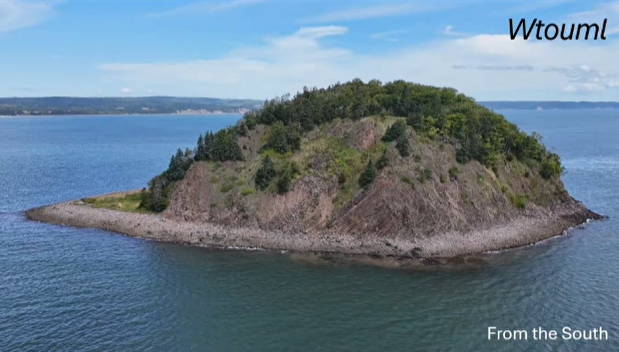
Tim Fedak, Curator of Geology with the Nova Scotia Museum, shared information on Spencer’s Island, traditionally known to the Mi’kmaq as Wtouml. He explained to the committee that the island has both geographical and cultural relevance to the Mi’kmaq.
“This is a really incredible place,” he said. “When you’re on the island, it feels very important.”
Tim spoke about the historical background of the island located in the Cliffs of Fundy UNESCO Global Geopark. Wtouml received scientific attention after a visiting tourist found a fossil, bringing it to the Fundy Geological Museum, Tim noted. That fossil is evidence of the pivotal geological changes that created the Wtouml we see today– specifically the catastrophic breaking up of the Pangea supercontinent, at the end of the Carboniferous Period, leading to the formation of the Bay of Fundy and the land masses all around it. The fossil, theorized to be a preserved bone from a prehistoric creature, also has direct ties to the name the Mi’kmaq legend surrounding Wtouml.
Traditionally, in local Mi’kmaw lore, Wtouml is regarded as the cooking pot or kettle of Glooscap, a reference to its shape, appearing to have its scraps poured out, scattered and turned to stone.
“That’s exactly what we found at the beach,” Tim said, describing how the connection between the contents of Glooscap’s pot, and the fossils strewn about the beach are a fascinating intersection of cultural legend and geological record.
He described a visit to the island where he studied the features of the island and found evidence of an environment that lends itself to fossil formation – sedimentary rock.
He told the committee his work continues and is excited that there is evidence of Triassic era fossils, potential for deeper research and proof that the local legend and presence of fossils suggest that bones have been observed for a remarkably long time.
Tim proposed a collaboration to share the Mi’kmaq and Western knowledge relating to the island, promoting its importance to the province.
Museum update
Later, Kayla Rudderham, Curator of Mi’kmaq Cultural Heritage with the Nova Scotia Museum, spoke about her role in the process of creating the Pjila’si Gallery at the Nova Scotia Museum.
Kayla described the work she did with the Mi’kmaq Advisory Group that formed to design Pjila’si in 2017, describing the ideas, processes and challenges encountered since the group was created in 2017.
The Mi’kmaq Advisory Group’s decisions determined what would be included in Pjila’si, bringing forward the knowledge, expertise and concerns of its communities regarding cultural heritage, to create a distinctly Mi’kmaw gallery that specifically reflected Mi’kmaq principles, values and customs, from the chosen items and material used for the gallery’s ceiling treatment, to the fonts and colours used, and the physical floorplan of the gallery.
Questions of what people should know, and take away, from the exhibits, and questions of themes, concepts and experiences guided the planning process, Kayla said, adding that a central theme became telling stories with objects in the collection, breaking from typical museum exhibit conventions.
The committee’s guidance resulted in an exhibit that focused on Indigenous resilience, with many featured community belongings, language as a central theme,
Kayla’s presentation was punctuated by a tour of the gallery, as part of the meeting, which took place at the Nova Scotia Museum.
June Anniversary
Keith Mercer, Cultural Resource Manager with Parks Canada, updated the committee on the plans to celebrate the anniversary of the signing of the First Peace and Friendship Treaty on June 4th, 1726.
Parks Canada has formed a Mi’kmaq-led steering committee to make plans to celebrate the 300th anniversary of the first treaty signed between the Crown and any First Nation in Canada. Keith noted that the event the committee is planning for June is a bid to honour that moment in history by hosting it at what is now the Fort Anne National National Historic Site in Annapolis Royal.
The committee, which has met twice this year, is working on event planning and fundraising.
Keith told committee members the event’s formal component will entail speeches and a plaque unveiling, with an informal component seeing the Fort Anne’s parade ground filled with activities, such as vendor and educational booths and cultural performances.